It is common startup wisdom that you should always aim to ship fast, gathering user feedback and other good things as soon as you can.
This also often gets translated to ‘do one thing and do it well’. Or the MVP concept from Eric Ries’ Lean Startup framework: a Minimum Viable Product, i.e. the smallest possible product that still gives a stab at adding value while already allowing learning from users how well it works.
There are also additional benefits to putting something out there early: you start to learn, and build muscle, on all the things surrounding the building of the product:
- getting code into production
- updating and handling different versions
- acquiring users
- presenting your product to the outside world.
All of these are non-trivial, and come beyond ‘working code on my local machine’. So they’re worth investing in as much early on as you do in writing code.
The MVP for Fun Plans: a catch-up list
The core goal of Fun Plans is helping you have a better social life with people already in your network.
So one of most natural MVPs for Fun Plans looks something like this: a flat list of contacts, a way to mark when you’ve last seen them, and a way to see how long it’s been.
In fact I have a friend who maintains exactly such a list in Notion: name, timestamp of last catch up, formula of how many ago the last catch up was.
Something like this:
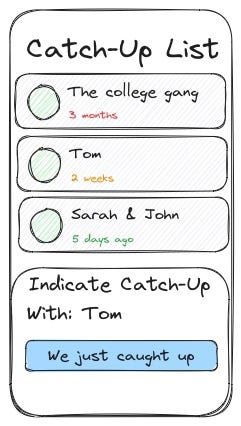
And indeed Fun Plans has that. Also, there’s a whole bunch of similar apps out there that have that, so it’s definitely a need others are trying to solve for in this way.
But is it enough? The answer might very well be yes. Ship that, and then iterate by adding notifications, more extensive contact ‘cards’, a beautiful and elegant design that people might fall in love with…
Your social life revolves around your calendar
But my conviction is that, whether explicitly or not, your social life is something you manage. And what you manage is the two core ingredients: people in your network, and the things you do together with those people. I.e. the events in your calendar.
And so, for me, any app aiming to help that social life, should somehow have front and center not just a (fairly static) list of people, but also the (much more dynamic) events happening with you and them. And ultimately help as much as possible with making those events happen beyond suggesting who to do it with.
So that’s why I gravitate towards ‘calendar’ type components, integration with your ‘regular’ Google Calendar, flows to easily organise things together, etc. Which is a bummer, because calendars are hard! Not just by themselves, with questions on how fine-grained should the resolution in hours-days-weeks should etc. But also, how would your ‘social calendar’ as managed by my app interact with your existing Google/Outlook calendar I assume you use?
(And is that assumption even correct? For now I’m operating under the assumption that it is)
But I’m hoping the compelling value proposition for Fun Plans to be that it takes all these components into play somehow, not just the people.
I know it is for me, the first ‘reference user’, so that’s a start. Because I tend to reason starting from the calendar: how might I fill up this empty-looking week with some fun plans?
I also believe that such an app would ultimately be much more continuously engaging: you open the app, you get a view of what’s coming up, and you get the tools and reminders etc to help you improve what’s coming up with some fun plans with people you like. And if you have fun plans coming up, the app helps put a smile on your face looking forward to them!
People+events also somehow feels like a more complete offering, one hopefully worth paying some (small) money for: an app that gives you a clear view on your social life, both how it is and how it could be, with the tools to manage that.
So that’s why Fun Plans feels pretty ‘feature rich’ (even bloated?) in bells&whistles from day 1. The goal is not ‘just’ knowing and being reminded about who to catch up with and when, it’s a full picture and help with all surrounding aspects as well, like holidays, birthdays, the weather, how empty or not your near/term calendar looks and where you might have some room to plan something fun, etc. So I think my true MVP is rather to have some shot at each of these components I view as useful for the ‘full picture’ of your social life.
But just a minimal version of each component.